

When most people think of auto transport, they picture a massive, two-story truck hauling nine cars down the interstate. While that multi-car trailer represents the industry standard for most moves, it doesn’t work for every situation.
Sometimes, you have a vehicle that simply cannot roll onto a standard ramp. When you face that problem, you need flatbed auto transport.
Whether you just bought a “project car” online or you need to move a heavy-duty work truck, understanding how flatbed transport works will help you choose the right shipping method and avoid delays.
Defining the Flatbed Truck
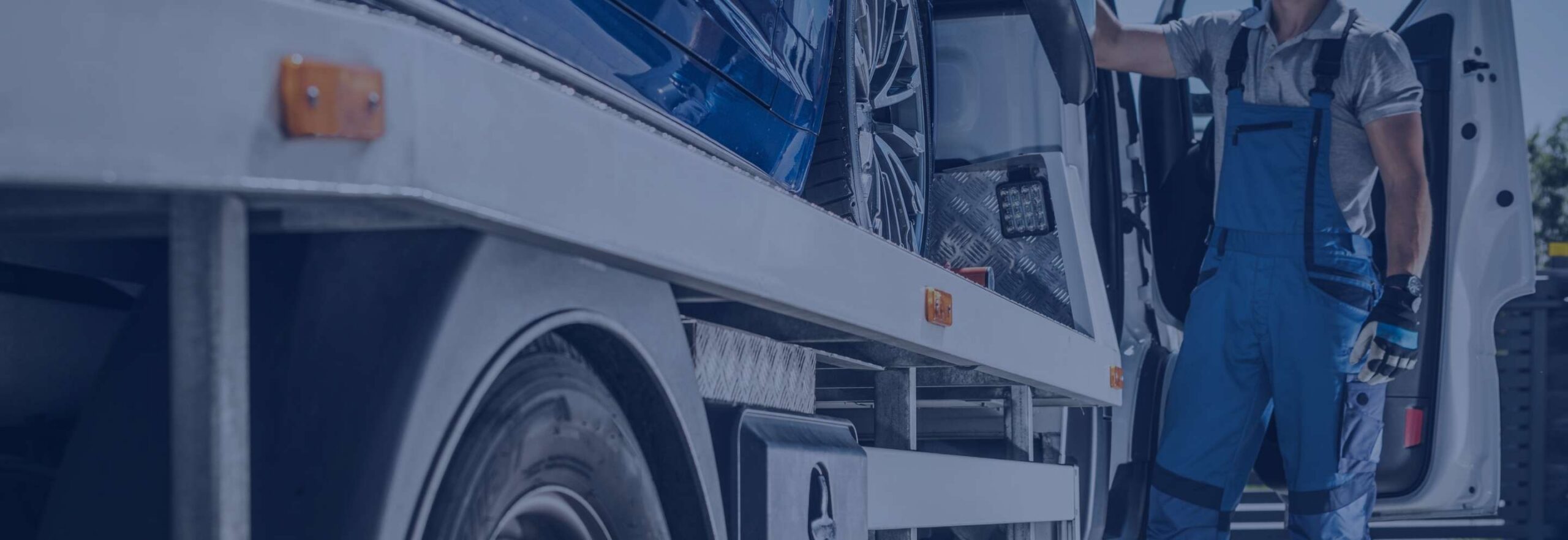
A flatbed transport truck features a long, open platform bed with no sides or roof.
To load a vehicle, the driver uses a hydraulic system to tilt the back of the bed down to ground level. The driver then drives the vehicle up the incline or uses a powerful heavy-duty winch to pull the vehicle onto the platform. Finally, the driver levels the bed and secures the vehicle’s tires to the deck using heavy-duty straps.
This method keeps all four wheels of your vehicle entirely off the ground during the trip, ensuring zero wear and tear on your transmission or tires.
When Do You Need Flatbed Auto Transport?
You do not need a flatbed for a standard, running sedan. However, flatbed transport becomes absolutely essential in the following scenarios:
1. The Vehicle Does Not Run (Inoperable)
If your car has a dead engine, a broken transmission, or missing keys, it cannot drive onto a standard multi-car hauler. Flatbed operators carry specialized winches. The driver attaches the winch cable to your car’s frame and safely pulls the dead vehicle up the ramp.
2. Severe Collision Damage
Cars involved in major accidents often have locked wheels, broken axles, or dragging bumpers. A standard carrier cannot load a car that cannot steer or roll safely. A flatbed provides a flat, stable surface to securely transport wrecked vehicles to a repair shop or salvage yard.
3. Oversized and Heavy-Duty Vehicles
Standard multi-car trailers have strict weight and height limits. If you need to ship a lifted 4×4, a dually pickup truck, or an oversized utility van, it will not fit on a standard carrier. A flatbed easily accommodates the extra width and weight.
4. Extremely Low Ground Clearance
Sports cars and modified vehicles often sit just inches off the ground. If the driver attempts to load a low-clearance car onto a standard steep ramp, the front bumper or undercarriage will scrape. The hydraulic tilt of a flatbed creates a much gentler loading angle. (Note: For high-value exotic cars traveling long distances, we highly recommend Enclosed Transport instead).
Comparing Your Options: Flatbed vs. Standard Open Transport
How do you know which one to choose? Here is a quick breakdown to help you decide.
| Feature | Flatbed Transport | Standard Open Transport (Multi-Car) |
| Best For | Non-running cars, heavy trucks, wrecks | Running sedans, standard SUVs, everyday drivers |
| Capacity | 1 to 2 vehicles | 7 to 9 vehicles |
| Loading Method | Winch or drive-on | Drive-on only |
| Cost | Higher (Dedicated truck) | Lower (Shared space) |
The RunBuggyOne Solution
Finding a flatbed driver with a winch can feel overwhelming if you try to do it yourself. RunBuggyOne makes it incredibly simple.
When you request a quote on our platform, you just need to tell us about your vehicle. If you check the box that says “Does Not Run,” our algorithm instantly calculates the exact cost for a winch-equipped flatbed and connects you with a vetted, specialized carrier who has the right equipment for the job.
You don’t have to guess what kind of truck you need. We handle the logistics, so you can focus on the rest of your move.
Do you need to move an inoperable or oversized vehicle?
Get a guaranteed price instantly and let our specialized carriers do the heavy lifting.